What to listen for?
In our podcast we examine and compare Justin Biebers online persona on Tiktok and Instagram through the lenses of media, semiotics, and interculturalism. Here's a guide to our main points, supporting data, and key arguments we cover, so you know exactly what to look out for.
Lens 1: Media
Two platforms, one celebrity
When comparing Bieber's TikTok to Instagram, the first thing you'll notice is how his media team have visual styled each profile. TikTok feels informal and spontaneous. trend led and casual, whereas Instagram is polished and well-curated, exhibiting professional images. Although, it transcends aesthetics. What communication is even feasible is shaped by the structural differences across the platforms.
Gee (2005) beliefs that every digital space has an exterior grammar, which consists of the customs and behaviours users build around it, and an internal grammar, which consists of the platform's design and intended purpose. Images and grids make up Instagram's internal grammar. Curation, aesthetics, and personal branding are the exterior grammar that developed around it. The internal grammar of TikTok is a brief audio video. Authenticity, fashion, and not being overly serious are the outward grammar. Both are directly addressed by Bieber's media team.
One of Bieber's earliest TikTok posts showed him and his wife Hailey dancing to a popular song. There was no caption or marketing attached to the video. His team simply joined in with what the platform was already doing. On Instagram (@lilbieber), the grid is expertly managed with excellent production quality and brand collaborations. Even his profile pictures reveal something. On TikTok, he is shown cradling his child Jack in a cosy and intimate manner, whereas on Instagram It's a stylised photo of his shoe brand SKYLRK (SKYLRK, Instagram, accessed May 2026).
Adami (2017) goes one step further by suggesting that platforms don't only affect how you communicate but also what you can communicate. Additionally, Bucher (2012) points out that algorithms are not impartial. They actively influence who is forced into invisibility and who is made visible. The For You Page on TikTok has the ability to share content with strangers in addition to your followers. Additionally, communicating with strangers requires an entirely new approach.

Bieber's casual, trend-driven, and intimate TikTok profile. The profile picture of his son Jack conveys warmth and genuineness (Gee, 2005).

Bieber's well-curated, polished, and well run Instagram account, @lilbieber. An entirely distinct external grammar compared to TikTok

The SKYLRK TikTok post. Nine seconds, no caption, no context (Kress & van Leeuwen, 2001)

Comment section under the SKYLRK TikTok video

Bieber's face replaced with the SKYLRK shoe. A bold transfer of cultural capital (Adami, 2017)

Lens 2: Semiotics
the SKYLRK case study
The SKYLRK campaign is the clearest demonstration of how the same product, communicated through different semiotic choices, can produce completely different results depending on the platform.
Bieber's media team uploaded a single, nine-second video on TikTok that featured a green shoe spinning on screen while his music played (Justin Bieber @justinbieber, TikTok, accessed May 2026). There was no background or caption. 3.2 million views seems remarkable at first glance. However, with only 59,000 likes and just a thousand comments, this is really his least popular video on the entire account. Even more telling is that the remarks are unrelated to the shoe. Fans commented pictures of Bieber as a child, sobbing emojis, and the phrase "I miss the old you." What was clear was that the product was hardly mentioned at all.
This is exactly what Kress and van Leeuwen (2001) imply when they argue that meaning is never produced by a single mode functioning alone but rather by all the modes working together. For a nine-second spinning shoe placed on a platform that prioritises individuality, authenticity, and entertainment, the weight of a promotional message is just too much. The indicators are inconsistent and do not add up to "buy this product." Additionally, because TikTok's For You Page promotes material to strangers who do not already have an emotional connection to Bieber, there is no foundation of trust to make the advertising sign land.
The strategy was quite different on Instagram. Bieber's team designed almost the entire profile around SKYLRK instead of just one video. The brand was mentioned in his bio. A photograph of the shoe took the place of his profile picture, which often featured his visage, one of the most potent cultural symbols on the platform. According to Adami (2017), a resource's meaning potential is influenced by its past usage. Instagram's profile photo space has significant cultural significance because it conveys presence and identity. It is a daring semiotic statement to replace his face with a product, "This brand is as significant as who I am."
The posts themselves consisted of several expertly taken photos with vibrant colours, striking lighting, and thoughtful layout. Importantly, there were no captions for any of them. Since language is the most culturally distinctive sign system available, this was a conscious semiotic decision. You select a language and instantly limit your audience when you write a caption. The photos become borderless when all text is removed. They can be received by anyone, anywhere. This is evident in the comments, which have almost 200,000 likes and consumer-friendly phrases like "need them," "awesome shoes." The shoe was interpreted by the crowd as appealing.
When all the modes cooperate rather than conflict with one another, this is referred regarded as multimodal coherence (Kress and van Leeuwen, 2001). Every indication on Instagram, including the profile picture, bio, photos, music, and missing description, led in the same direction. They didn't on TikTok. The main contention here is not that one platform is superior to another, but rather that semiotic decisions are only effective when they are appropriate for the appropriate audience in the appropriate setting.
SKYLRK on Instagram — multimodal coherence in action (Kress & van Leeuwen, 2001)
Lens 3 - interculturalism
Interculturalism in the comment sections
The intercultural depth of Bieber's online persona is most apparent in the comment sections of his posts. With a celebrity of his magnitude, it is assumed that the comment section reflects a single, cohesive worldwide fan base. Over the course of the 40 posts we examined, that presumption rapidly breaks down.
In reality, you find several distinct groups occupying the same area simultaneously. These are what Blommaert and Varis (2015) refer to as "light communities", transient organisations that emerge around a common experience, engage momentarily, and then disband. There is neither a common past nor a steady membership. Only now. Brazilian fans, Portuguese fans, Spanish speakers, Indonesian fans, and devoted English-speaking followers all show up in the same thread but rarely engage with one another. This is exactly how Bieber's comment sections looks.
The most obvious example is perhaps the Portugal flag post (Justin Bieber, @lilbieber, Instagram, accessed May 2026) . The entire comment section changed when a picture of a Coachella crowd featured a Portuguese flag in the backdrop. Fans wrote, "Portugal mentioned, I can't breathe" as well as "he didn't forget us." At suddenly, a whole nationwide fandom emerged and recognised themselves in a single picture. This was one community talking to itself in a common area, not communication across communities.
However, participation does not equate to equal visibility. A distinct trend can be seen when you examine which comments are most popular. Nearly all of the most popular comments on the Coachella posts were written in English, with phrases like "he's an icon, he's a legend and he is the moment" receiving thousands of likes. The algorithm continues to magnify these comments since they are culturally understandable to the largest possible audience. In the meantime, a Brazilian fan who wrote "eu amo vocüge" (I love you) got one like before vanishing. This demonstrates Bucher's (2012) claim that the algorithm actively determines whose voice rises and whose sinks rather than being neutral.
The fact that fans who don't speak English don't switch to English is what makes this so intriguing. "Te amo" appears under nearly every post we looked at, indicating that Spanish-speaking fans remain in Spanish. The comment area beneath a fishing shot was radically changed by Indonesian admirers, who flooded it with "mancing mania", fishing mania, a cultural reference that is only understandable from within that particular cultural context. These groups are not making an effort to be heard by everyone. They are conversing in a setting that was never truly intended for them, within their own cultural circles.
This is highlighted in the Palantir post. English-speaking fans were genuinely incensed when they learned that Bieber had performed at an event connected to dubious organisations, asking, "Why are you supporting dangerous companies?" Portuguese admirers wrote "te amo," German fans wished Hailey a happy Mother's Day, and Spanish fans expressed love and enthusiasm right next to those remarks. same post. conversations that are quite different. Adami (2017) contends that individuals from diverse cultural origins are not necessarily communicating with one another just because they share a digital space. Whether or not they have similar meaning systems is what counts.
This is explained by the idea of "parasocial connections" proposed by Horton and Wohl in 1956. Fans develop sincere emotional bonds with superstars they have never met, but when they open the app, their feelings are influenced by politics, society, language, and whatever is going on in their own world. Even if a fan in the UK and a fan in Brazil both adore Justin Bieber, their reactions are entirely different.
The conclusion is significant. A worldwide community is not inherently created by a global platform. What appears to be a single comment area is actually a number of overlapping ones, each with its own language, emotional register, cultural allusions, and visibility. Shared meaning does not equate to shared space. A Brazilian fan's gentle "te amo" at four in the morning vanishes almost instantly, English rises, and political rage spreads as the computer discreetly chooses who gets heard in the background.

Fans who speak Spanish are remaining in their native tongue; "te amo" occurs under nearly all of the examined posts.
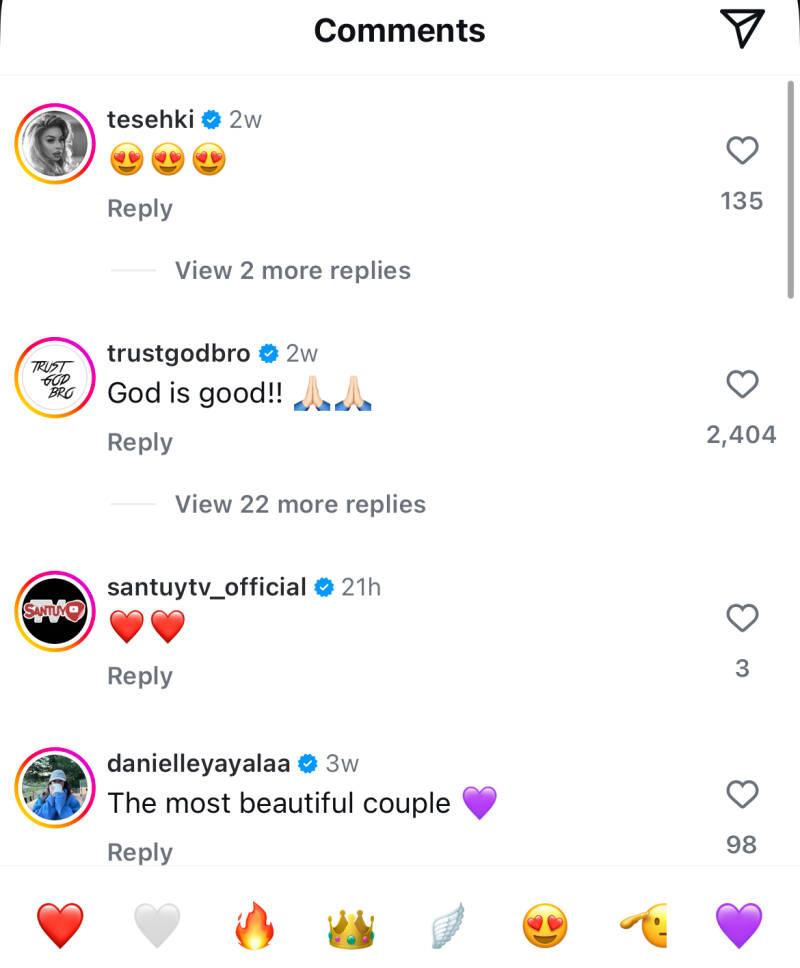
English comments are the most visible at the top; algorithmic power determines who has a voice (Bucher, 2012).